Sunday, 26 October 2014

City Gardens Walk Map


Start at Mansion House station.
Turn right into Queen Victoria Street, next to Huggin Hill.
Cross the road into Friday Street and onto Cannon Street.
Cross New Change into St Paul's Churchyard.
Out of the churchyard and into Queens Head Passage to Newgate Street.
Turn into King Edward Street.
Continue past Angel Street, through Postmans Park and onto St Martins Le-Grand.
Turn right onto London Wall and continue to Monkwell Square (via car park entrance)
Back onto London Wall, and round into Aldermanbury Square.
Back to Aldermanbury and turn into Love Lane.
Across Wood Street, through St Albans Court and into Oat Lane.
Continue to Noble Street and down to Gresham Street - end.

Goldsmiths' Garden

On the site of the medieval church of St John Zachery and opposite Goldsmiths Hall. The garden is on two levels, the former churchyard on higher ground:


and a sunken level reached by steps which is the excavated site of the church. In 1950 it won the Best Garden on a Blitzed Site. Redesigned by Peter Shepherd in 1962, the lower garden features a water fountain.


There is seating around the garden and a sculpture entitled 'Three Printers' representing the newspaper process, with a newsboy, a printer and an editor.


Nesting boxes for blue tits have been cleverly incorporated into the brick walls.


The garden is now part of Lloyds HQ, and they have developed the garden theme by installing flower boxes on the outside of the entrance facade, which continue the garden onto the building.


Noble Street Garden


Sunken garden amidst the excavated remains of the Roman Wall dated AD 100 and ruins uncovered by bomb damage during WW II. It is adjacent to the refurbished Plaisterers Hall 
The garden was planted with windflowers and grass in 2004.


St Mary Aldermanbury Garden

Situated in Love Lane on the site of St Mary Aldermanbury church, which was destroyed in the Great Fire. It was rebuilt afterwards by Wren and then gutted during the Blitz. The remaining walls were transported to Fulton, Missouri and rebuilt as a College memorial to Sir Winston Churchill.


Also in the gardens is a monument, topped by a bust of William Shakespeare to John Hemminge and Henry Condell, who were his co partners at the Globe theatre and were responsible for producing the first editions of his plays.


In the grounds is a Swamp Cypress tree, which stands adjacent to the Wood Street Police Station horse stables.


Notable people buried here - Judge Jeffrey's, known as the 'hanging judge'


Aldermanbury Square

Originally laid out in 1962, after war damage, with symmetrical arrangements of flower beds, lawn, paving and some seating. 

It was redeveloped for the Millenium and is now a traffic free public space featuring rows of planted table-topped plane trees (stunted) and water feature jets in the pavement. 


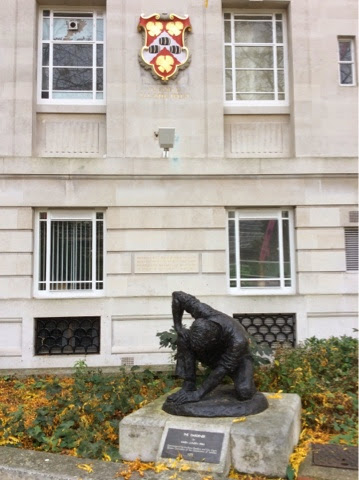
Also in the gardens is a bronze statue by Karin Jonzen called The Gardener.


Barbican

There are over 12 miles of window boxes in the Barbican estate. The lease does not insist that window boxes be used, but it does require that if they are planted, that they should be kept cultivated. They cannot be removed, and any new additions must be of the standard type.


Around the corner to Barber Surgeons Garden the space opens up to a lake bordering the Barbican high rises.

There is an annual competition for the best kept window boxes, which are now Grade II listed.


Barber Surgeons Physic Garden

The garden was created from a bomb site after WW2 and is sited next to Barber Surgeons Hall in Monkwell Square, Wood Street. 


Remains of the Lomdon Wall can also be seen here, and the garden is next to the 13th bastion (out of 21) which may also have been once been used as an 'operating theatre' or Anatomical Theatre in the 1500s.


The Physic garden seeks to recreate how plants might have been used in the past for medicinal and surgical reasons. In 1607, a horticulturalist named John Gerard referred to plants and herbs that related to surgery, dentistry, wounds and burns which he grew in his own Physic garden in Holborn. The original herb garden here was planted to meet the needs of Gerards work on this matter when he was Master of the Barber Surgeons Company.

The present garden dates from 1987. There are around 45 different herbs and fragrant plants, with descriptions of their uses in medicine.